Rigorous methods, from question to paper.
Give your coding agent the habits of a careful methods team. Plan the analysis, review the methods, and trace the results in R or Python. You keep the scientific decisions.
A research plugin for Claude Code and Codex, with workflows for clinical statistics, machine learning and meta-analysis.
Open source. MIT licensed. Your team stays accountable.
# install the plugin
claude plugin install methodsmith --marketplace sajor2000/methodsmith

# in your project, inside Claude Code
> /methodsmith:method-setup
> /methodsmith:method-workflow

# then plan before any analysis runs
> /methodsmith:method-plan
  a cohort study of 30-day mortality
Requires Claude Code 2.1.292 or later. Other agents and managed laptops.
67 skills, 55 specialist agents, 49 reporting standards.
Browse the full toolkitWatch the 90-second tour
A researcher's questions, one scene each: which reporting guideline applies, where to start the literature, how to sharpen the question, the analysis plan, data checks in R or Python, figures and tables, and the first Results draft. You make every call.
You decide. Methodsmith does the legwork.
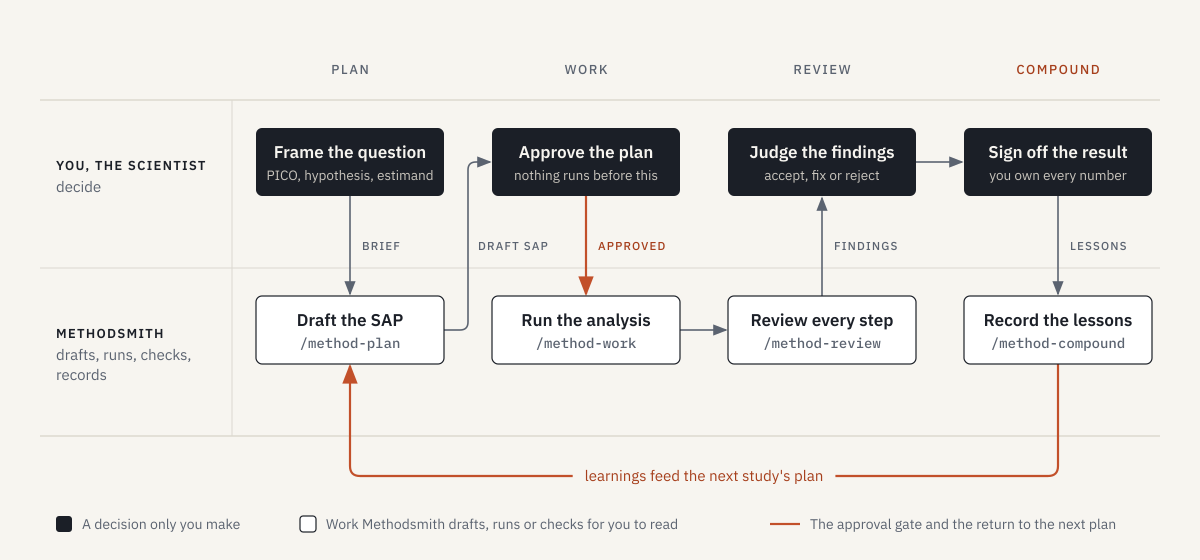
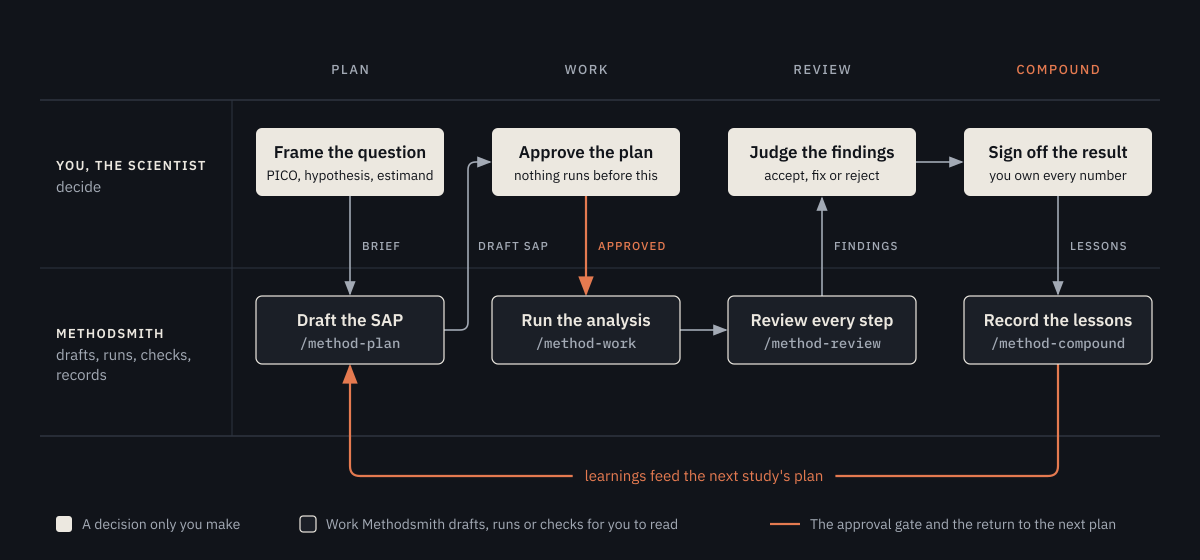
Your team frames the question, approves the plan and judges the findings. Methodsmith drafts, runs and checks the work around those decisions. The plan, work, review and compound loop comes from Every's Compound Engineering.
Plan
Your teamFrame the question and approve the analysis plan.
MethodsmithDraft the SAP, assumptions and planned outputs.
Work
Your teamResolve decisions and authorize the analysis.
MethodsmithExecute approved tasks and track SAP outputs.
Review
Your teamJudge findings and decide what needs to change.
MethodsmithCheck methods, code, reporting and reproducibility.
Compound
Your teamChoose which validated lessons to retain.
MethodsmithDocument decisions for the next study.
Validated lessons feed the next plan. Every study compounds.
See it on synthetic data
Find the next step, link a causal claim to its estimand, then review the analysis before anyone reads the results.

In this example, the plan has two unresolved decisions. Review returns Not ready, with findings for the researcher to resolve, not an automatic sign-off.
Built for three kinds of study
67 skills in total. These are the ones each kind of study reaches for first.
Clinical statistics
Observational studies, trials and registries, from question to Table 1.
/method-questionPICO, FINER and a hypothesis/method-powersample size and power, with a script/method-sapclaims linked to ICH E9(R1) estimands/method-cohortreproducible cohort and waterfall counts/method-table1traceable baseline-characteristics table/method-numbersevery reported number traced to the analysis
Python and ML papers
Prediction models and notebooks that survive peer review.
/method-model-choicejustify the model after the estimand/method-ml-trackdata hashes, splits and metrics/method-verifyleakage, effect direction and PHI gate/method-model-cardcalibration, fairness and limits/method-marimoreactive, reproducible Python notebooks/method-figurecalibration, ROC and forest plots
Meta-analysis
Systematic reviews and pooled effects with every source cited.
/method-lit-searchPubMed, full text or authoritative sources/method-evidence-mapa source-backed evidence map/method-preregPROSPERO, OSF or ClinicalTrials.gov/method-meta-analysisrandom effects, REML with Hartung-Knapp/method-checklistPRISMA 2020 and its extensions/method-writeevidence-bound manuscript drafts
Why you can check its work
Methodsmith drafts and checks. The researcher decides, and stays accountable for every result.
- Research use only
Methodsmith is not a medical device for clinical care and is not intended to diagnose, treat, or guide decisions about individual patients. Research outputs require qualified human review.
Read the research-use scope- 49 reporting standards
Reporting guidelines, appraisal tools and templates, including CONSORT, STROBE, PRISMA, TRIPOD+AI and TARGET, encoded with their official item IDs. A test enforces routing to the newest version of each guideline.
Check the guideline sources- An explicit sensitive-data boundary
Claude Code’s pre-tool hook restricts data reads in schema-only mode and checks identifiers in supported WebSearch, WebFetch, MCP, and shell egress inputs in every mode. Other agents rely on skill instructions. These safeguards are not a sandbox or a substitute for institutional approval.
Read the safeguards and their limits- 55 specialist agents
Methods, causal inference, leakage, calibration, fairness and reproducibility reviewers are part of a broader team of research and workflow agents. Review findings are deduplicated and confidence-gated.
Explore the skills and agents- Numbers traced to the analysis
Manuscripts, tables and abstracts cite a registry written by the analysis code. A fail-closed gate traces each number to its SAP output, script commit and source hash. It does not read numbers inside images.
See how number provenance works
The skill map
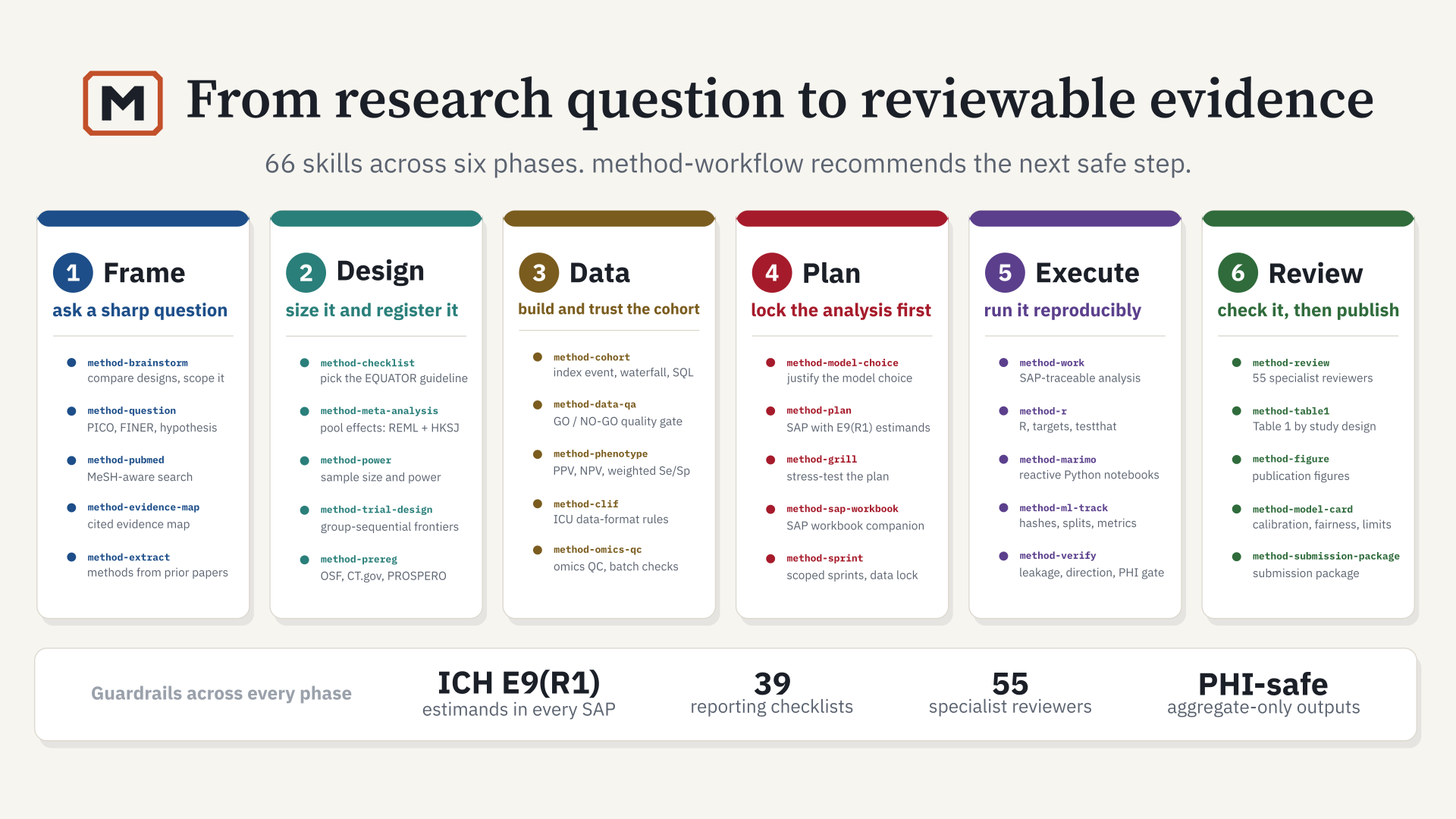
Thirty of the 67 skills, in the order a study meets them, with the guardrails that apply at every step.
View the study lifecycle map
Install once, set up each project
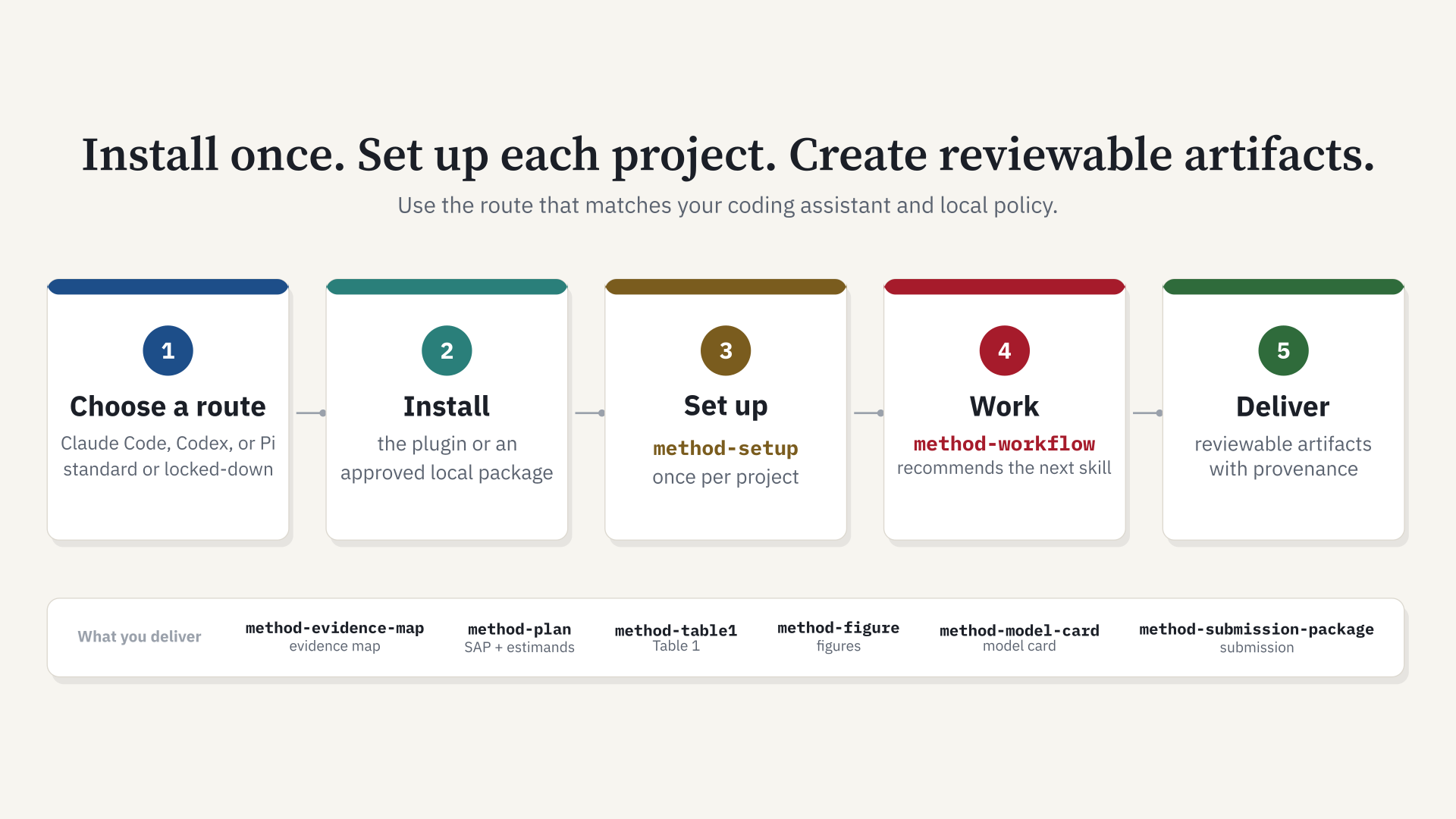
Start with Claude Code or Codex. The setup guide also covers Pi, OpenCode, Gemini CLI, Kiro, Qwen Code and approved offline installs. Then open your study folder and run setup for that project.
View the installation workflow
Credits
Methodsmith is a fork of Compound Engineering by Kieran Klaassen and Every, which introduced the plan, work, review, compound loop for software. Methodsmith adapts it for research methods and is maintained by Juan Carlos Rojas. MIT licensed.